
The Art of Patience: A Gentleman's Guide to Smoking Meat
For those who understand that the finest things in life cannot be rushed — an introduction to the ancient craft of smoking meat.
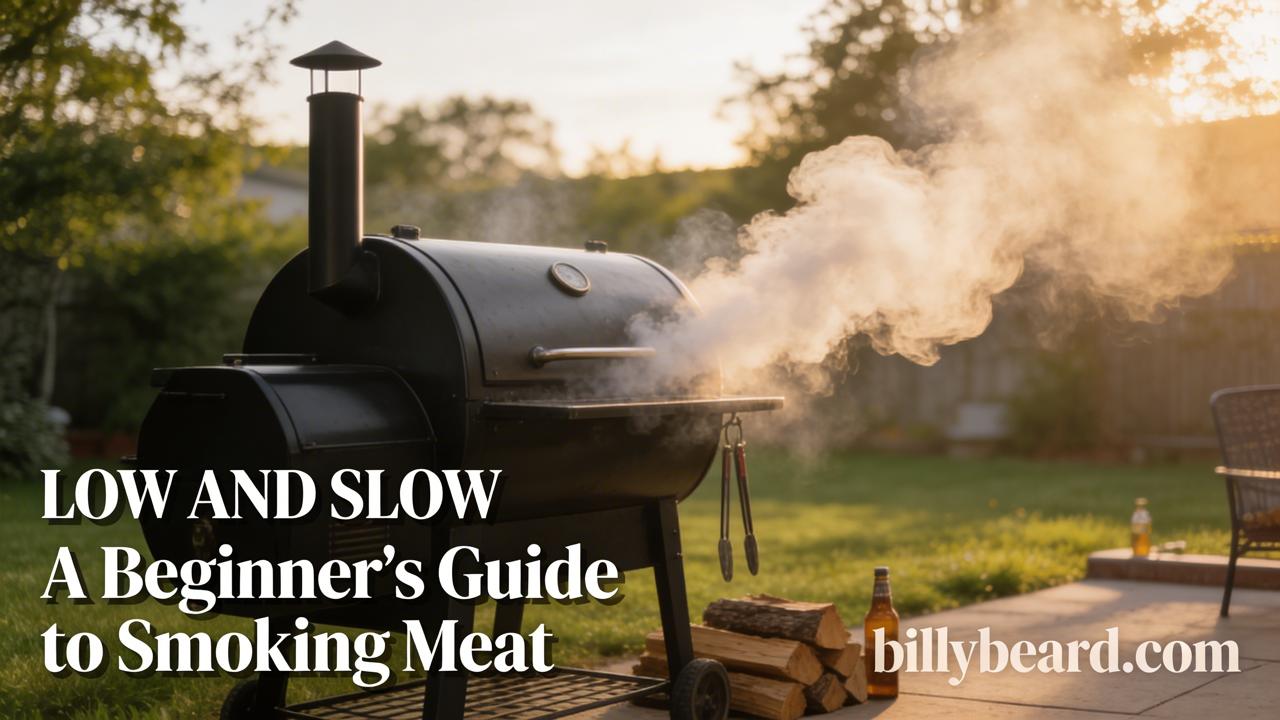
A gentleman knows that the finest things in life cannot be rushed. A proper aged whiskey. A well-worn leather journal. And, perhaps most rewarding of all, a piece of meat transformed by nothing more than smoke, patience, and time.
The art of smoking meat is not merely cooking — it is an exercise in restraint, a meditation on craft, and ultimately, a deeply satisfying pursuit for those who appreciate the journey as much as the destination.
If you have found yourself curious about this ancient practice, allow me to offer some guidance.
The Distinction: Smoking Versus Grilling
First, let us establish the fundamental difference between these two worthy pursuits.
Grilling is direct, immediate — high heat applied for minutes to achieve a seared exterior and succulent interior. It is the quick conversation at a cocktail party.
Smoking is altogether different. We speak of temperatures between 225-275°F, maintained for hours — sometimes the better part of a day. This low, persistent heat breaks down the stubborn connective tissues that make lesser cuts tough, while wood smoke permeates every fiber with complexity and depth.
Think of it as the difference between a brief acquaintance and a friendship forged over years. Both have their place, but only one achieves true depth.
The Essential Implements
A gentleman need not possess the finest equipment to produce excellent results, but certain tools prove indispensable.
On the Matter of Smokers
Several worthy options present themselves:
- The kettle grill — Should you already possess a Weber, know that it can serve double duty. Not ideal, but serviceable for the apprentice.
- The bullet smoker — The Weber Smokey Mountain represents perhaps the finest value for those beginning their journey. Reliable, forgiving, and capable of remarkable results.
- The offset smoker — The traditionalist’s choice. Requires more attention and skill, but rewards dedication handsomely.
- The pellet smoker — Modern convenience for the time-pressed gentleman. Consistent, if somewhat less romantic.
The Non-Negotiables
- A proper thermometer — This is not optional. A dual-probe digital thermometer — one probe monitoring the meat, another the chamber — removes guesswork entirely. To smoke without one is to navigate without a compass.
- Quality wood — Your choice of wood determines your flavor profile. We shall discuss this presently.
- A spray bottle — For maintaining moisture on the surface. Apple cider vinegar serves admirably.
- Time — Clear your calendar. This pursuit does not accommodate impatience.
The Selection of Wood
Wood is not merely fuel; it is the signature you impart upon your craft. Consider your options thoughtfully:
| Wood | Character | Best Suited For |
|---|---|---|
| Hickory | Bold, reminiscent of fine bacon | Pork, ribs, beef |
| Apple | Gentle, subtly sweet | Poultry, pork |
| Cherry | Mild, fruity, imparts beautiful color | Versatile; particularly poultry |
| Oak | Medium intensity, dependable | Beef, especially brisket |
| Pecan | Nutty, refined | An excellent all-purpose choice |
| Mesquite | Intense, earthy | Use sparingly; can overwhelm |
For the beginner, I recommend apple or cherry wood. Both are forgiving of heavy-handedness and produce consistently pleasing results.
Three Principles of the Craft
The First Principle: Temperature Discipline
Your chamber should maintain between 225-275°F. This range is sacred.
Too hot, and the exterior toughens before the interior has time to become tender. Too cool, and you court both food safety concerns and interminable cook times.
This is why the thermometer matters. The dial on your smoker — if it has one — lies with remarkable consistency. Trust your instruments, not the manufacturer’s optimism.
The Second Principle: Time as a Range
“How long shall it take?”
The honest answer: until it is ready.
While guidelines exist — roughly ninety minutes per pound for pork shoulder — every piece of meat possesses its own character. Internal temperature and texture tell the true story.
- Pork shoulder achieves perfection at 195-205°F internal
- Ribs are done when they bend gracefully and the meat retreats from the bone
- Brisket reaches its apex at 195-205°F, when a probe slides through with no resistance — “like butter,” as the Americans say
The Third Principle: The Virtue of Restraint
You will be tempted to check your progress. To lift the lid “just for a moment.”
Resist this urge.
Every opening releases precious heat and smoke, extending your cook by fifteen minutes or more. Trust your thermometer. Trust your process.
“If you’re looking, you’re not cooking.” A crude expression, perhaps, but wisdom nonetheless.
The Stall: A Test of Character
At some point — typically around 150-170°F internal temperature — your meat will cease to rise in temperature. It will remain stubbornly fixed for what feels like hours.
This phenomenon, known as “the stall,” is not a failure of your technique. It is physics — moisture evaporating from the surface creates a cooling effect, much as perspiration cools the body.
You have two options:
- Wait with patience — The purist’s approach, though it adds hours to your endeavor
- The wrap — Encasing your meat in butcher paper or foil at the stall accelerates the process
I confess to wrapping more often than not. Life is short, and the results remain excellent.
Cuts for the Apprentice
I implore you: do not begin with brisket. It is a demanding cut that has humbled many an overconfident beginner.
Instead, consider these more forgiving options:
Pork Shoulder
The ideal starting point. Economical, remarkably forgiving of minor errors, and capable of producing pulled pork that will earn you considerable admiration.
Chicken
A shorter commitment — two to three hours — that teaches temperature control without requiring an entire day’s dedication.
Pork Ribs
St. Louis cut or baby back, as you prefer. More technique involved, but a reasonable five to six hours from start to finish.
Chuck Roast
What some call “the poor man’s brisket.” Similar technique, a fraction of the time, and a forgiving tutor.
Your First Endeavor: Pulled Pork
When you are ready to begin, may I suggest the following:
Required:
- One bone-in pork shoulder, eight to ten pounds
- Yellow mustard, as a binder for the seasoning
- A dry rub of your choosing (or simply salt, pepper, paprika, garlic powder, and brown sugar)
- Apple or cherry wood chunks
- Apple cider vinegar in a spray bottle
The Method:
-
The evening before: Apply a thin coat of mustard to the shoulder — this helps the seasoning adhere. Apply your rub generously. Wrap and refrigerate overnight.
-
Morning: Remove the meat one hour before cooking to temper. Bring your smoker to 250°F.
-
The cook begins: Place the pork with the fat cap facing upward. Add your wood. Close the chamber and step away.
-
Maintenance: Every ninety minutes after the first two hours, a brief spray of apple cider vinegar. Nothing more.
-
The stall: Around 160°F, wrap in butcher paper if you wish to proceed more quickly.
-
Completion: The meat is ready at 203°F internal, when your probe meets no resistance.
-
The rest: This step is essential. Rest the wrapped meat for no less than one hour — two is preferable — in a cooler lined with towels.
-
The reward: Shred with forks, incorporate the accumulated juices, and serve.
Total duration: Ten to fourteen hours, including rest. An early start is advisable.
Pitfalls to Avoid
- Insufficient fuel — Running low mid-cook creates panic where calm is required
- Neglecting the rest — This period allows juices to redistribute; skip it at your peril
- Excessive smoke — Thin, blue smoke is the goal; thick white billows indicate combustion problems
- Impatient adjustments — Small vent changes, not dramatic interventions
- Premature slicing — The rest is not a suggestion
A Final Thought
Your first smoke will likely not achieve perfection. Mine certainly did not.
But that first bite of meat you have crafted yourself — the bark, the smoke ring, that remarkable tenderness — nothing quite compares to the satisfaction.
Begin simply. Learn your equipment. Take notes on what succeeded and what requires refinement.
And above all, embrace the process. Low and slow is not merely a cooking method. It is a philosophy.
A gentleman understands this intuitively.
Until next time — may your smoke run thin and blue.