
The Essential Tools of a Gentleman Pitmaster
A curated guide to the grilling tools worth owning — no gimmicks, no gadgets collecting dust, just the essentials a serious pitmaster actually uses.
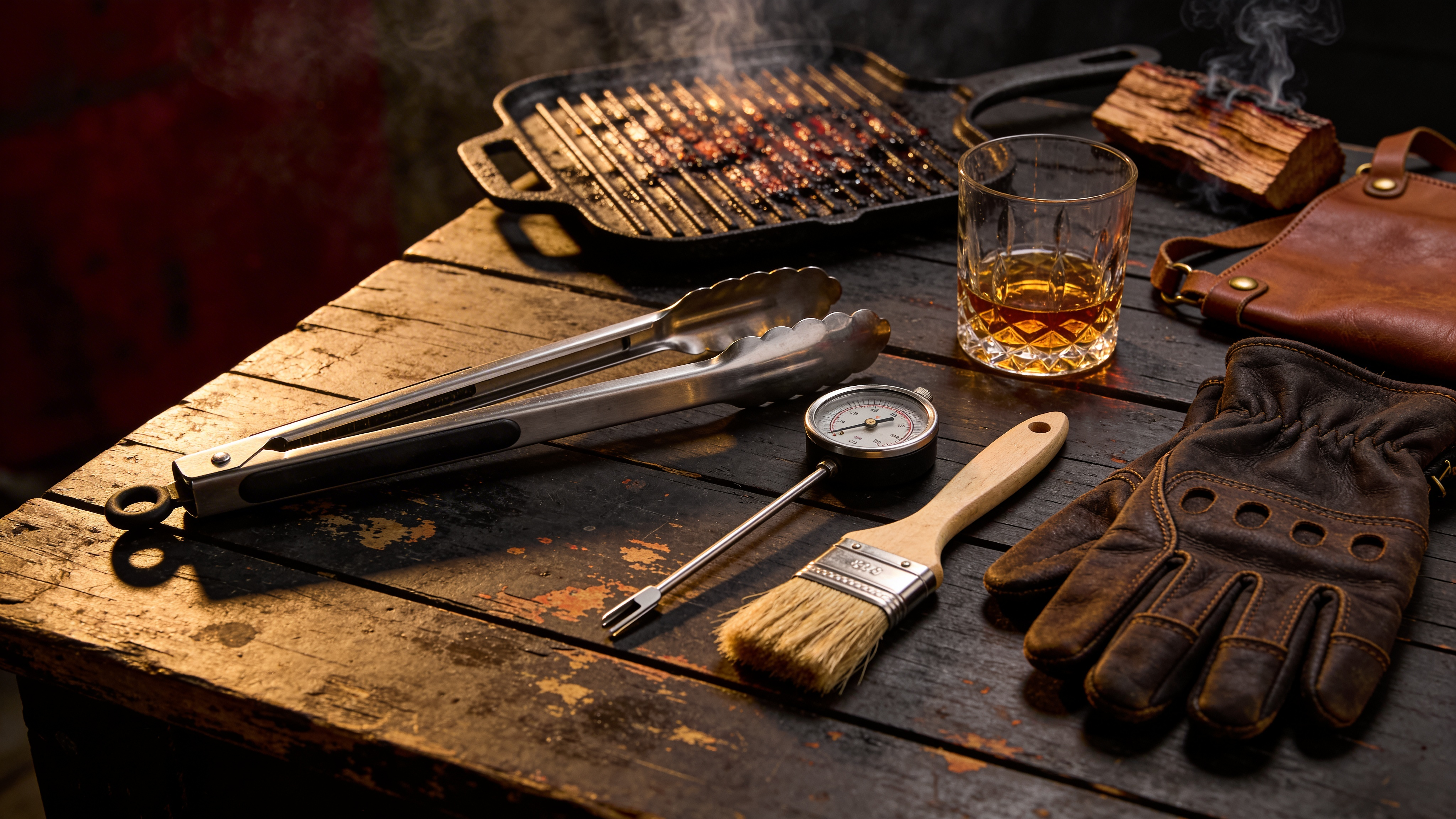
Every man who’s stood before a smoker at dawn knows the feeling.
The fire’s breathing. The wood’s starting to catch. And there, arrayed on the workbench like a surgeon’s instruments, lie the tools that separate hope from certainty.
A gentleman pitmaster doesn’t need much. But what he needs, he needs to trust completely.
The Philosophy of Essential Tools
Walk through any home goods store and you’ll find walls of grilling gadgetry. Motorized rotating racks. Bluetooth-enabled meat probes that sync with your phone. Novelty spatulas shaped like guitars. Each promises to revolutionize your cookout.
Most will disappoint you. Many will break. Some will actively make your food worse.
The truth that experienced pitmasters learn — often through expensive trial and error — is that great barbecue requires remarkably few tools. But those few tools must be excellent.
Quality over quantity. Function over novelty. Durability over convenience.
This is the way.
The Non-Negotiables
Heavy-Duty Tongs
Your tongs are an extension of your hands. They flip. They turn. They probe. They rescue. They rearrange coals and shift wood chunks and pull racks from the heat.
Cheap tongs bend. Cheap tongs slip. Cheap tongs conduct heat up their handles until you’re holding a branding iron.
What you want: 16-inch stainless steel locking tongs with scalloped edges for grip and spring tension that doesn’t fatigue your hand over hours of work. The extra length keeps your knuckles away from the heat. The locking mechanism means they store flat. The weight should feel substantial in your hand — flimsy tongs telegraph flimsy commitment.
Avoid anything with rubber grips (they melt), wooden handles (they crack), or clever mechanisms that add failure points. Simple, solid, steel.
A Reliable Thermometer
If you’re guessing at temperature, you’re not cooking. You’re gambling.
The internal temperature of your meat is the only objective measure of doneness that matters. Everything else — timing charts, appearance, the “poke test” — is approximation at best, delusion at worst.
Two types deserve space in your kit:
An instant-read probe thermometer for checking meat. Look for accuracy within one degree, response time under three seconds, and a thin probe that doesn’t leave gaping holes in your brisket. Digital is fine here — speed matters when you’re losing heat through an open smoker lid.
A leave-in probe thermometer for monitoring ambient temperature. Many smokers lie about their internal temperature. A leave-in probe at grate level tells you the truth. Some pitmasters run two: one for the meat, one for the cooking chamber.
The old-timers who claim they don’t need thermometers aren’t being honest. They’ve simply internalized thousands of hours of temperature feedback until instinct does the work their probe used to do. You’re not there yet. Neither am I, most days.
A Proper Basting Brush
Mopping, basting, saucing — whatever you call it, applying liquid to meat over fire is fundamental technique.
Silicone brushes are popular because they’re dishwasher-safe and don’t shed bristles. They’re adequate. But they don’t hold liquid the way natural bristles do, which means more trips to the bowl and more heat lost through the open lid.
A gentleman pitmaster keeps a natural bristle brush with a long wooden handle. Yes, it requires hand-washing. Yes, it will eventually wear out. But it carries sauce like nothing else, and the long handle keeps you safe from flare-ups.
Keep a separate brush for each flavor profile. The brush that mops vinegar shouldn’t touch your sweet Kansas City sauce. Cross-contamination of flavor is the mark of a careless cook.
Heat-Resistant Gloves
There comes a moment in every cook when you need to grab something hot.
Lifting a full brisket from the grate. Adjusting a stubborn grill grate. Moving a cast iron pan that’s been sitting over coals. In these moments, you need protection that doesn’t compromise dexterity.
Heavy leather welding gloves remain the gold standard. They’re rated for temperatures that would melt silicone alternatives. They provide grip when wet with grease or mop. They last for years with minimal care. And they look like something a blacksmith would respect.
The tradeoff is reduced finger sensitivity — you won’t be doing fine work in welding gloves. Keep a pair of thinner heat-resistant gloves (silicone or aramid fiber) for tasks that require more touch.
The Second Tier
These tools aren’t strictly essential, but serious work becomes easier with them in your arsenal.
A Heavy Spatula
For burgers, fish, vegetables, and anything else that needs to slide rather than grip, a spatula outperforms tongs. Look for a wide, thin blade that can slide under delicate items without tearing, and a sturdy handle that won’t flex under the weight of a loaded portobello.
Offset handles keep your knuckles away from the heat. A beveled leading edge slides easier than a squared-off one. And please — no slots or perforations. You want a solid surface for lifting.
Meat Claws
When it’s time to pull pork shoulder or shred chicken, nothing beats a pair of meat claws. They look barbaric. They work beautifully.
The alternative — two forks — tears meat unevenly and takes twice as long. Claws let you shred a whole shoulder in minutes while it’s still hot enough to render the remaining fat into the meat.
A Cast Iron Grate
If your smoker came with thin wire grates, consider replacing them with cast iron.
The thermal mass of cast iron provides superior sear marks. It holds temperature more consistently. It’s virtually indestructible with proper care. And once properly seasoned, it develops a nonstick surface that releases meat cleanly.
The weight is the only downside. Cast iron grates are heavy enough to make removal a two-hand job. Worth it.
A Quality Fire Starter
Lighter fluid is for amateurs and arsonists.
A chimney starter lights charcoal perfectly every time, using nothing but newspaper and patience. No chemical taste. No petroleum residue. No risk of flare-ups from excess fluid.
For wood-fired cooks, keep a box of fatwood — resin-impregnated kindling that catches easily and burns hot enough to ignite larger splits. Natural, effective, and honorable.
What You Don’t Need
Let me save you some money and drawer space.
Grill lights. If you need artificial light to see your meat, you need to check your meat less often. Open the lid when necessary, work quickly, and close it again. Your food will thank you.
Electric starters. They work, but they’re slow and create one more thing to break. Chimney starters are faster and immortal.
Motorized rotisseries. Unless you’re cooking for crowds regularly, manual turning achieves the same result with one less electrical component to fail at an inopportune moment.
Multi-tools. The spatula-tong-bottle-opener-flashlight combo is a marvel of engineering and utterly useless for serious work. Each of those functions deserves a dedicated tool that does it properly.
Bluetooth anything. Your smoker doesn’t need wifi. You don’t need an app. You need to be present with your fire, learning its rhythms through attention rather than notification.
Care and Maintenance
Tools that serve you well deserve care in return.
Steel tongs and spatulas need nothing more than hot soapy water and thorough drying. If they develop rust spots, scrub with steel wool and a paste of baking soda, then dry immediately.
Natural bristle brushes should be washed in warm water with a drop of dish soap, then hung to dry completely between uses. Replace them when bristles start falling out — no one wants to eat brush hairs.
Leather gloves should be conditioned occasionally with neatsfoot oil or leather balm. Store them flat, not crumpled, to maintain their shape.
Cast iron requires the most attention. Clean while warm with a stiff brush and hot water — no soap. Dry immediately over low heat. Apply a thin coat of oil before storage. Never leave it wet. Treat it well and it will outlast you.
Thermometers need calibration checks. Submerge the probe in ice water (should read 32°F) and boiling water (should read 212°F at sea level, adjusted for altitude). If either reading is off by more than two degrees, recalibrate according to manufacturer instructions or replace.
The Gentleman’s Approach
Accumulating tools is easy. Anyone with a credit card can fill a drawer with gadgets.
Building a collection of essentials — each one chosen deliberately, used frequently, maintained carefully — requires discipline. It requires knowing the difference between what you want and what you need.
A gentleman pitmaster arrives at the smoker with intention. His tools are few, but they’re exactly right. Each one has earned its place through repeated service. Each one fits his hand like it was made for him — because through countless hours of use, it effectively was.
This is the path. Not through acquisition, but through refinement.
Start with what you need. Learn what you don’t. And let the fire teach you everything else.
Until next time — may your tools be worthy of your craft.