
The Crispy Wing Problem: Why Your Smoked Wings Come Out Rubbery (And How to Fix It)
Rubbery smoked wings aren't a skill problem — they're a science problem. Here's the pellicle-and-finish method that gets crackling skin every time.
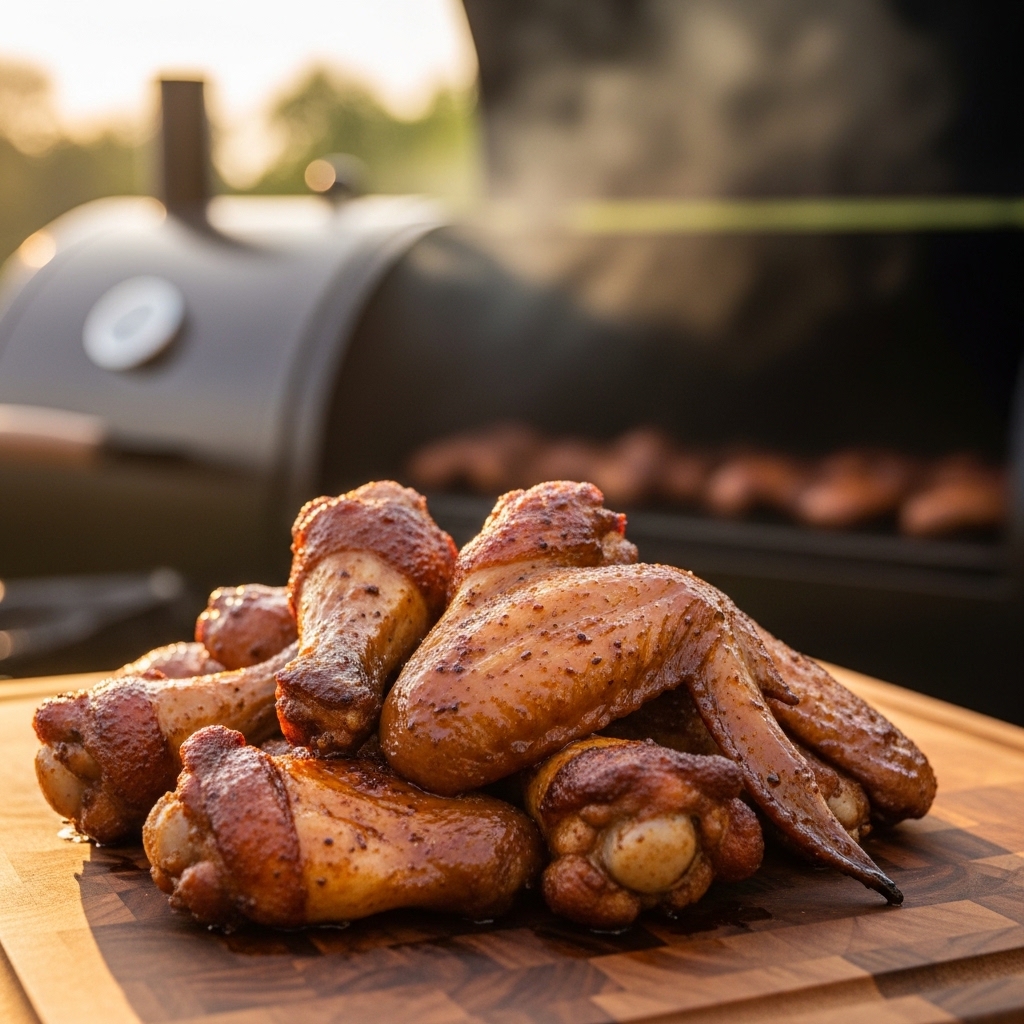
Every backyard pitmaster has been there. You pull a rack of wings off the smoker — beautiful mahogany colour, smoke ring visible through the skin — and you bite in to find… rubber. Not crispy. Not crackly. Just soft, yielding skin that peels away in one disappointing sheet.
You followed the recipe. You ran the smoker at the right temp. You didn’t rush it. And still: rubber.
Here’s the thing a gentleman learns early: this isn’t a skill problem. It’s a science problem.
Why Chicken Skin Goes Rubbery in the Smoker
Chicken skin is roughly 75% water and loaded with collagen. To render that collagen and evaporate that moisture — the two things that create crispiness — you need sustained high heat. But the sweet spot for absorbing smoke flavour is low and slow: 225–250°F (107–121°C).
At those temperatures, you’re building flavour beautifully. You’re also steaming the skin from the inside. Subcutaneous fat is rendering, but not fast enough to fully crisp before the smoke phase ends. The moisture trapped under the skin has nowhere to go.
The result: flavour that’s excellent. Texture that’s a disappointment.
The solution is a two-phase approach — but the real key happens before the wings ever hit the grates.
Phase 1: The Pellicle
A gentleman does not rush the pellicle.
After seasoning your wings (salt, garlic powder, a touch of baking powder — more on that shortly), place them uncovered on a wire rack in the refrigerator for a minimum of 4 hours. Overnight is better. What you’re waiting for is the pellicle: a thin, tacky, semi-dry film that forms on the surface of the protein as moisture evaporates.
The pellicle does two things:
- It helps smoke adhere — giving you deeper, more consistent smoke penetration
- It gives the skin a head start — less surface moisture means the skin crisps faster once heat is applied
That small addition of baking powder (1 tsp per pound of wings, mixed into your dry rub) raises the skin’s pH slightly, which accelerates the Maillard reaction — the browning and crisping process. It’s the same trick used in Chinese restaurant-style roasted poultry, and it works magnificently.
Phase 2: The Low Smoke Phase
Set your smoker to 250°F (121°C). Use a moderate wood — apple or cherry for wings. Hickory and mesquite are too aggressive for a shorter cook; you’ll get bitterness before you get bark.
Place wings directly on the grates, not in a pan. Airflow beneath the wings is critical — you want heat and air circulating around the entire surface.
Smoke for 45 to 60 minutes. You’re not cooking them through here; you’re building the bark and smoke profile. Internal temp at the end of this phase should be around 140–150°F (60–65°C).
Pull the wings off. Let them rest, uncovered, for 5–10 minutes on a wire rack. You want any remaining surface moisture to evaporate before the finish.
Phase 3: The High-Heat Finish
This is where most recipes stop short — and where most wings fall flat.
Crank your heat source to 400–425°F (204–218°C). This can be:
- A ripping-hot half of a charcoal grill (direct heat)
- A gas grill on high
- A cast iron grill pan in an oven at 425°F
- The high-temp zone of a pellet grill
Return the wings to direct, high heat. Cook 4–6 minutes per side, watching closely. You’re looking for visible bubbling of the skin as the remaining subcutaneous fat renders completely, then the tight, crackly finish that only high heat creates.
The two-phase method separates the flavour development (low + smoke) from the texture development (high + render). Trying to do both at once is the source of every rubbery wing story you’ve ever told around a fire.
The Full Playbook
Ingredients (for 2 lbs wings):
- 2 lbs chicken wings, split into flats and drumettes
- 1 tsp kosher salt per pound
- 1 tsp baking powder per pound
- 1 tsp garlic powder
- 1 tsp smoked paprika
- ½ tsp black pepper
- ½ tsp cayenne (optional, for heat)
Timeline:
- Night before: Season wings, place uncovered on wire rack, refrigerate overnight
- Day of, 45 min before: Remove from fridge, let sit at room temp 20–30 min
- Smoke phase: 250°F, 45–60 minutes, apple or cherry wood
- Rest: 5–10 minutes uncovered
- Finish: 400–425°F, 4–6 minutes per side
Sauce (if desired): Toss finished wings in sauce after the crisp phase. Never sauce before the finish — sugar burns before skin crisps.
On Wood Selection
A word on wood, because it matters more with poultry than most pitmasters admit.
Chicken has a delicate flavour. Fruitwoods — apple, cherry, peach — complement it without overpowering. Cherry in particular gives wings a deep mahogany colour that looks as good as it tastes.
Avoid mesquite entirely on wings. Avoid hickory unless you’re after a very assertive smoke note and you keep the smoke phase short (30 minutes maximum).
When in doubt: apple wood, every time. It forgives, it flatters, and it never competes.
A Gentleman’s Final Note
The best smoked wings aren’t the ones you threw on at noon and pulled at six. They’re the ones you started thinking about the night before — seasoned, rested, approached with patience and intention.
That’s the real lesson of the pellicle. Not that you need to do more work. But that you need to do the right work earlier. The smoker rewards the thoughtful man.
Fire it up.